
Blog
Loan Origination Software in Kenya

Loan Origination Software in Kenya
How Loansoft helps Kenyan lenders originate, verify, score and approve loans efficiently.
What Is Loan Origination Software (LOS)?
A Loan Origination System (LOS) is the workflow engine that manages a loan from the first borrower interaction through to final approval and hand-off for disbursement. It captures applicant and loan details, enforces document checklists, runs identity and credit checks, scores risk, routes files to the appropriate approvers, and keeps a complete audit trail for compliance and internal audit.
In Kenya, an effective LOS should support local lending realities: product-specific forms for salary-backed, SME, asset-finance and group loans; integrations with identity and credit-data providers; and approval workflows that reflect branch, management and board credit committees.
Why Multi-Channel Origination Matters in Kenya
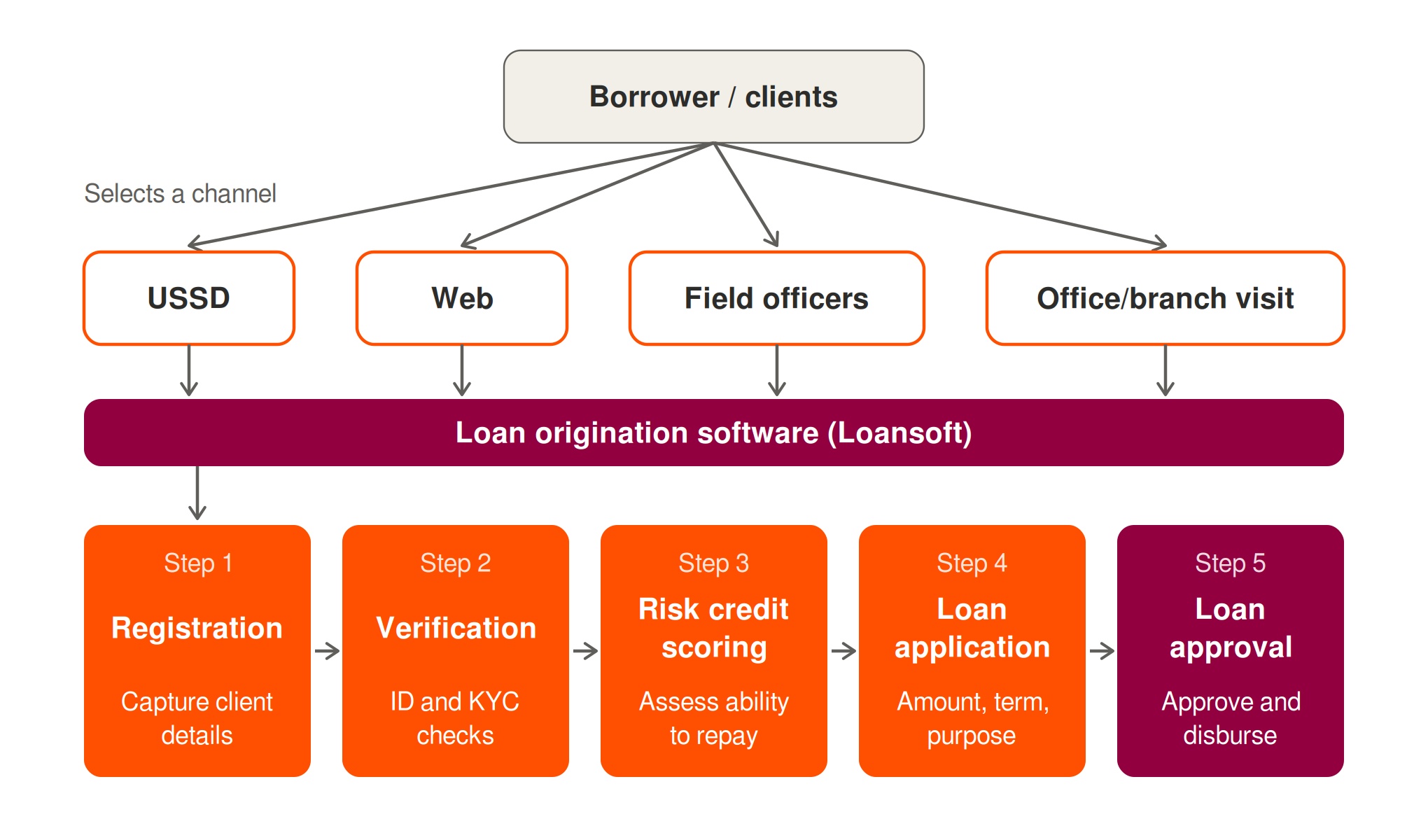
Borrowers in Kenya do not come through one door only. Some apply online, some use USSD, some work with field officers, and many still visit physical branches or offices. A modern LOS should unify all these channels in one pipeline so that every borrower has a single profile and every application follows consistent lending rules.
- Every lead and application is stored under a unique borrower profile.
- Verification, scoring, policy rules and approval processes remain consistent across channels.
- Lending teams can monitor application volumes, turnaround times, SLAs and bottlenecks from one dashboard.
- Duplicate applications and fragmented borrower records are reduced.
Multi-Channel Origination: Web, USSD, Field Portal and Office Visits
1. Web Portal for Self-Service Borrowers
A responsive borrower web portal gives customers a convenient way to begin their loan journey at any time. It is suitable for digital lenders, Fintechs, micro-credit and asset-finance providers that want to reduce manual branch work while collecting complete, standardised application data.
- Browse available loan products such as salary advances, SME working-capital loans, asset finance and business loans.
- Complete quick eligibility checks based on income, employer, business turnover or loan purpose.
- Fill in structured application forms and save progress before submission.
- Upload supporting documents such as ID copies, payslips, M-Pesa statements, bank statements, logbooks and collateral documents.
- Accept digital declarations, consent requests and terms and conditions.
2. USSD Channel for Feature-Phone Borrowers
USSD remains important for reaching borrowers who use feature phones, have limited internet access or prefer a simple menu-based experience. It can support first-time registration, basic pre-qualification, application initiation, consent capture and status updates.
- Register using a National ID number and mobile phone number.
- Select a loan product and enter basic details such as the amount, purpose and employment or business type.
- Receive OTPs and provide consent for identity and credit checks.
- Receive real-time status messages, including application received, under review, approved, declined or pending documents.
The LOS should treat USSD applications like web or branch applications: one borrower profile, one set of lending policies and one consistent workflow.
3. Field Officers Portal
For SME, agri-lending, group lending and relationship-driven lending, field officers need a secure portal that works on mobile devices or laptops. It enables officers to originate and assess applications while visiting customers, businesses and groups.
- Capture leads and applications in the field.
- Record GPS coordinates, photos of business premises, collateral and supporting evidence.
- Complete borrower, guarantor and group-member information.
- Upload field-visit reports, cash-flow assessments and credit recommendations.
- Track outstanding documents, application status and assigned portfolio performance.
4. Office and Branch Walk-Ins
Physical offices remain important for borrowers who prefer face-to-face support, have complex documentation or need assistance completing an application. Loansoft allows branch or office staff to capture walk-in applications using the same digital workflow used by web, USSD and field teams.
- Capture applications on behalf of walk-in borrowers.
- Scan or upload documents against product-specific checklists.
- Perform immediate identity and CRB checks where policy permits.
- Issue a clear application reference and communicate the next steps to the borrower.
Leads and Borrower Verification Using IPRS and Other APIs
Before credit assessment begins, lenders must establish that an applicant is genuine and that the information submitted is accurate. A well-configured LOS supports verification workflows through APIs and internal review queues.
IPRS Identity Verification
IPRS (Integrated Population Registration System) verification helps lenders validate a borrower’s National ID details against official records. This strengthens Know Your Customer (KYC) controls and reduces fraud caused by fake, altered or mismatched identity documents.
- Validate National ID details, including the applicant’s name and date of birth where available.
- Identify mismatches between application details and identity records.
- Flag exceptions for manual verification before a file proceeds to underwriting.
- Create an auditable record of verification activity and results.
Additional Verification Checks
- KRA PIN validation for tax identity checks where applicable.
- Sanctions and politically exposed person (PEP) screening to support AML controls.
- Business registration checks for SMEs, companies and registered enterprises.
- Employer, payroll, guarantor, collateral and address verification based on the lender’s credit policy.
Risk and Credit Scoring Using CRB, M-Pesa and Bank Statements
After identity verification, the LOS assesses credit risk and affordability. Strong lending decisions should use multiple data sources rather than depend on a single score. Loansoft can bring CRB data, M-Pesa statements, bank statements, employment information and field assessments into one borrower profile for faster, more defensible lending decisions.
CRB Data and Credit Scoring
Credit Reference Bureau (CRB) data is a key input to credit assessment in Kenya. Through approved integrations with CRB providers, the LOS can retrieve a borrower’s credit information and use it in configured risk rules and credit-score models.
- Retrieve credit reports showing existing credit facilities, arrears, defaults and repayment behaviour.
- Perform CRB status or negative-list checks in line with the lender’s credit policy.
- Receive a credit score or risk grade where the service provides one.
- Use CRB results to determine eligibility, loan limits, pricing, security requirements or manual-review conditions.
For example, a lender may automatically decline an applicant whose CRB result fails its minimum policy criteria, reduce the approved amount for a borrower with repayment stress, or offer more favourable terms to a borrower with a strong repayment record.
M-Pesa Statements and Mobile-Money Cash Flow
For many Kenyan borrowers, particularly informal businesses, micro-enterprises and mass-market customers, M-Pesa activity provides an important view of real cash flow. With borrower consent, a lender can analyse M-Pesa statements or API-derived transaction data to better understand income patterns and repayment capacity.
- Estimate average monthly inflows and outflows.
- Identify regular income sources such as salary credits, customer payments or recurring business receipts.
- Assess cash-flow stability, seasonality and transaction frequency.
- Identify potential stress indicators such as persistent overdraft use, irregular large withdrawals or high-risk spending patterns.
- Calculate affordability indicators using actual mobile-money activity.
M-Pesa statement analysis is especially useful where borrowers have limited formal financial records but conduct most of their personal or business transactions through mobile money.
Bank Statements and Financial Behaviour
Bank statements give lenders a more formal view of a salaried borrower’s income, an SME’s turnover and a customer’s broader banking behaviour. Loansoft can support document uploads or integrations with statement-analysis services, depending on the lender’s operating model and approved data providers.
- Analyse salary credits, business receipts and other income patterns.
- Categorise transactions into income, operating expenses, loan repayments and discretionary spending.
- Compare declared income or turnover against actual account activity.
- Identify overdrafts, returned cheques, unstable balances and recurring debt repayments.
- Support cash-flow-based lending decisions for SMEs and business borrowers.
Combining bank-statement analysis with CRB data helps lenders confirm affordability, identify possible repayment pressure and offer a loan amount and repayment period that match the borrower’s actual capacity.
A Unified Risk Decision
A well-designed LOS should not rely on one data source. It should combine CRB information, M-Pesa activity, bank statements, borrower documents and field assessments into a configurable credit scorecard or decision model.
- Apply different scoring weights by product and borrower segment.
- Place greater weight on M-Pesa cash flow for micro-loans and informal businesses where appropriate.
- Place greater weight on bank statements, financials and collateral for SME and asset-finance lending.
- Generate a credit proposal with the recommended amount, tenor, pricing, risk grade and decision drivers.
- Keep a clear audit trail explaining how the lending decision was reached.
From Loan Application to Final Approval
A modern loan origination workflow brings every stage into one controlled process, from the first enquiry to approval and disbursement readiness.
- Application intake: The borrower applies through the web portal, USSD, field officer portal or office. The LOS captures product selection, amount, purpose, personal or business details, documents and consent.
- Verification: The system runs configured checks such as IPRS, KRA PIN, sanctions/PEP, business checks and employer or guarantor checks. Exceptions are routed to a verification queue.
- Credit assessment and scoring: The LOS retrieves CRB information, reviews M-Pesa and bank statements, calculates affordability and generates a credit proposal with a risk grade and recommended terms.
- Approval routing: Based on loan amount, product, risk grade and delegated authority, the application is routed to the relevant credit officer, branch committee, management committee or board-level approver.
- Conditions precedent: Approved applications are checked for outstanding documents, guarantor acceptance, security perfection, insurance, legal documentation and other conditions before disbursement.
- Disbursement hand-off: Once every condition is met, the approved loan is passed to the loan management system, core banking platform or payment/disbursement process. The LOS maintains the complete approval and audit history.
Why Loansoft Is Ideal for Kenyan Lenders
Loansoft provides a practical, configurable and Kenya-focused loan origination solution for digital lendersand asset-finance providers. It helps lending teams digitise borrower acquisition, standardise credit assessment and control the full path from application to approval.
- True multi-channel origination: Support web applications, USSD, field officers and office walk-ins within a unified borrower and loan pipeline.
- Kenya-focused integrations: Connect identity, credit, payments and verification services to reduce manual work and support faster decisions.
- Stronger risk assessment: Combine CRB results, M-Pesa statements, bank statements, employment information and field reports in one credit assessment workflow.
- Configurable lending workflows: Define product forms, documentation requirements, eligibility rules, scorecards, approval matrices and delegated limits to match your institution’s policy.
- Faster turnaround times: Automate data capture, checks, task allocation, reminders and approval routing to reduce delays.
- Audit and compliance readiness: Maintain role-based access, maker-checker controls, decision logs and a complete audit trail.
- Scalable for multiple products: Originate salary loans, personal loans, business loans, SME facilities, group loans and asset-finance products through one platform.
Build a Faster, Safer Loan Origination Process with Loansoft
Loansoft gives Kenyan lenders the tools to originate loans through every major borrower channel, verify identities, assess affordability using CRB, M-Pesa and bank-statement data, and route applications through controlled approval workflows. The result is a faster borrower experience, stronger credit decisions and better operational control as your loan book grows.
Talk to Loansoft today to explore a loan origination workflow tailored to your lending products, credit policy and integration requirements.